History at Our Fingertips
In our family, as I’m sure it is for other families with survivors of the Holocaust, it is easy to go down rabbit holes to find information. Over the past several years, I’ve found myself periodically, for weeks at a time, searching to find documents that feature my grandfather’s family and their mead businesses.
Since I started this journey, I’ve found close to a hundred documents that prove the Löw family owned at least six mead wineries in Poland as well as birth, death, and marriage records in registries. It is important to note that the documents my family collectively has found, feature my grandfather’s story of his survival of the Holocaust, including dates of entries into concentration camps and liberation papers. It is emotional each time we find a new document.
Later this month we plan to host our first event and pop-up exhibition, called Roots of Survival, dedicated to sharing my grandfather’s Holocaust story; it will be told by my mother and my brother. Preparing for this event has brought back memories of my grandfather and the feelings that I had when I showed him newly discovered documents that mentioned his family members.
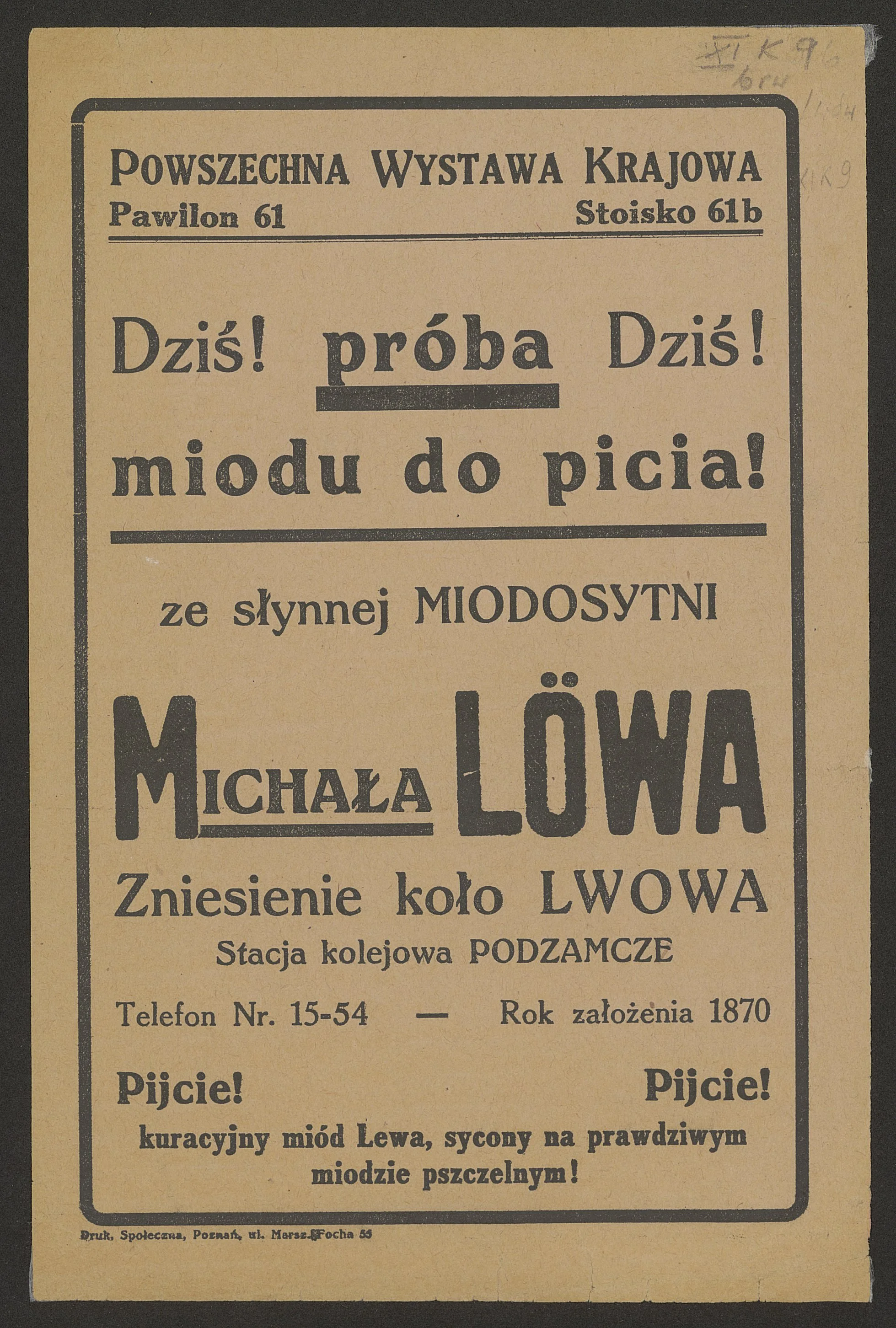
In 2021, I randomly received a Facebook message from a Polish fellow named Marek who sent me a screenshot of an advertisement of Mechel’s (my grandfather, William’s, uncle) meadery at Poland’s General Exhibition—a landmark national exhibition held in 1929 to celebrate a decade of Poland’s independence. He sent me the picture and followed up with “Don’t you know this?” For context, six months prior I had posted in a mead Facebook group with thousands of people from all over the world who love mead. Marek and I both belong to this group. I posted a picture of my great-great-grandmother, Malka’s meadery label from 1870. Nothing came out of my post despite the numerous comments until Marek found the advertisement after his own periodic searching for evidence of my family’s businesses.
Anyway, I was shocked. I showed my grandmother immediately and we decided to print out the advertisement to show my grandfather. My heart was racing as I walked the advertisement up to the house. I walked in and handed the advertisement to my grandfather. He exclaimed, “that’s my uncle!” My grandfather had a huge smile on his face, looked at me and asked, “how did you find this?” This was the first time he saw his uncle’s name in print. My grandfather marveled at it like he was looking at a photograph of his uncle. It is easy to assume that since the Löw family owned businesses and were prominent figures in Lwów, that they would be featured in publications such as tribunes and directories. I guess we had assumed that most of these documents would have been destroyed between WWII and the Communist era. I am eternally grateful that they exist.
My grandfather survived the Holocaust. Most of his family did not. His family’s heirlooms, pictures, and businesses were all destroyed between 1939 and 1941. So, each of these documents we’ve found over the years, although we are not in possession of the originals, has felt like an heirloom and proof of existence. Marek most likely did not know that he created a rabbit hole for me to jump into for the past five years. Since the day he introduced me to the Polish Library of Archives, I’ve discovered more documents like the advertisement of Mechel’s meadery. It was an addicting feeling to see my grandfather’s face light up with each document I was able to show him over that next year before he passed away. Marek, a Pole, who does not know me personally, has become a valuable part of my quest to find information about my grandfather’s family.
When I think about my grandfather, which is often, there are two ways that I feel closer to him and the Löw family. One, is to continue my search for old documents that showcase the Löw family’s past. We are still, even at the four year mark of his passing, learning about him. Two weeks ago we even found an old print of his childhood home in Lwów! The second, has been to create meads in honor of his family members. The practice of bringing memory to life in a product that is symbolic provides purpose and a new way of creating an heirloom.
An heirloom is, by definition, a valuable object passed down through generations. Our family’s mead recipe—carried through generations—is invaluable; and when brought to life as a finished product, it holds both meaning and value. When we name a mead after a family member, they become more than a memory. Each mead becomes an heirloom—one that we not only preserve within our family, but also share with all of you, inviting you to become part of our story and carry it forward.
I can’t imagine a better way to honor my grandfather and his family and I can’t wait to share with you everything we’ve found over the years.